
Europa Clipper Captures Rare Ultraviolet View of Interstellar Comet

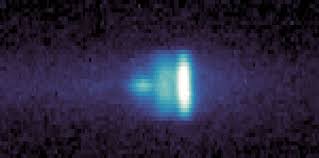
NASA’s Europa Clipper spacecraft obtained unprecedented ultraviolet observations of interstellar comet 3I/ATLAS while the object remained obscured from Earth-based telescopes by the Sun’s glare. The Europa Ultraviolet Spectrograph instrument recorded detailed spectra of the comet’s dust and plasma tails from a distance of approximately 103 million miles on November 6, 2025. This vantage point allowed views of tail structures and compositions inaccessible from ground observatories during the comet’s solar conjunction phase. Southwest Research Institute researchers led the analysis of these opportunistic data collected en route to Jupiter.
The observations revealed distinct ultraviolet emissions from ionized gases and reflected sunlight off dust particles in the comet’s extended tails. Spectral lines indicated the presence of carbon monoxide and other volatiles sublimating from the nucleus as it approached perihelion. Plasma tail features showed interactions with the solar wind, including disconnection events where magnetic reconnection severed portions of the ion tail. Dust tail brightness profiles provided constraints on particle size distributions, ranging from micron-scale grains to larger fragments.
3I/ATLAS marks the third confirmed interstellar object detected in the solar system, following ‘Oumuamua in 2017 and 2I/Borisov in 2019. Its hyperbolic trajectory confirmed origin outside the solar system, with a velocity exceeding the Sun’s escape speed by approximately 10 kilometers per second. The comet exhibited a pronounced coma and tail development, distinguishing it from the more asteroid-like ‘Oumuamua. Pre-discovery observations traced its entry into the solar system from the direction of the constellation Lyra.
Europa Clipper’s instruments activated early in the mission cruise phase to calibrate against known celestial targets. The unexpected alignment with 3I/ATLAS enabled bonus science without impacting primary objectives focused on assessing Europa’s habitability. Researchers combined these ultraviolet data with visible-light images from ground telescopes before and after conjunction to construct a comprehensive model of the comet’s activity cycle.
This encounter demonstrated the scientific flexibility of deep-space missions to capitalize on transient astronomical events. Interstellar comets offer pristine samples of material from other stellar systems, preserving chemical records from their formation epochs billions of years ago. Analysis of 3I/ATLAS spectra constrains abundances of primordial ices and organics, informing models of exoplanetary system chemistry.
The findings highlight challenges in observing objects near the Sun and the value of space-based platforms for continuous monitoring. Future missions may incorporate similar opportunistic targets to maximize scientific return. Data from this observation undergo archiving for public access through NASA’s Planetary Data System. Ongoing analysis refines estimates of the comet’s nucleus size, estimated at several kilometers based on production rates.
This rare glimpse advances understanding of interstellar visitors and their potential role in distributing complex molecules across star systems. The ultraviolet perspective complements multi-wavelength studies essential for characterizing these fleeting objects. Europa Clipper continues toward Jupiter arrival in 2030, with additional calibration opportunities planned.