Nvidia Launches GeForce RTX 50 Series with Blackwell Architecture

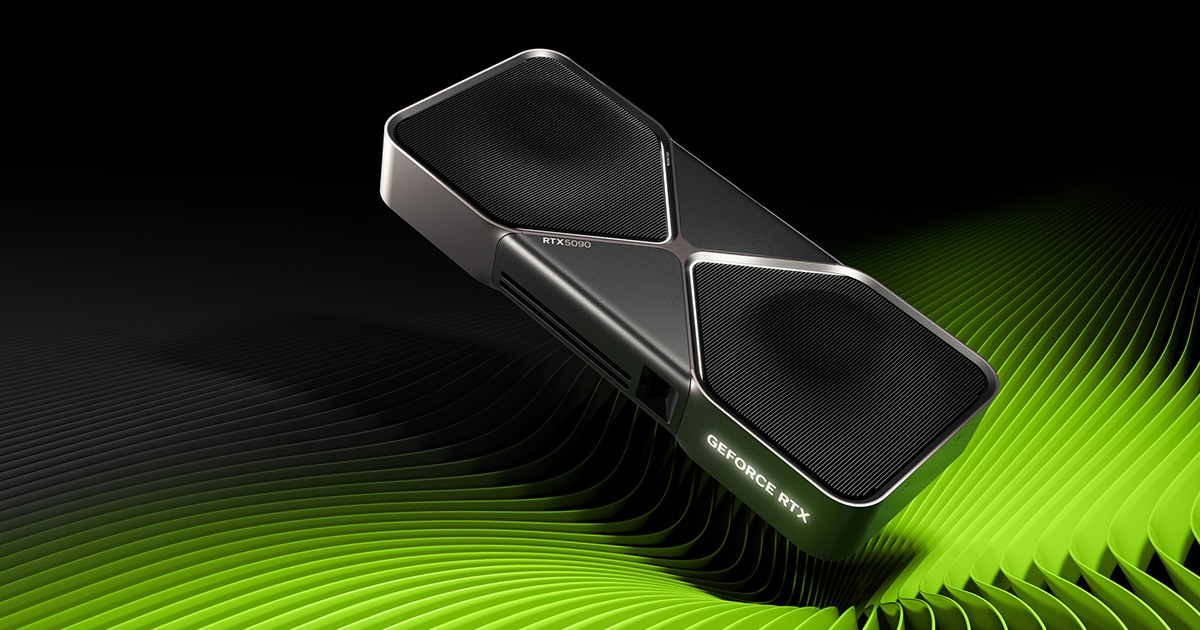
Nvidia has introduced the GeForce RTX 50 series graphics cards and laptops powered by the Blackwell architecture, targeting gamers and creators with unprecedented AI acceleration. These GPUs promise up to 8x frame rate boosts in games through DLSS 4 Multi Frame Generation and 75 percent latency reductions via Reflex 2. The lineup marks a shift toward neural rendering, enabling real-time AI-driven enhancements in graphics fidelity and creative workflows.
The flagship GeForce RTX 5090 features 92 billion transistors and delivers 3,352 trillion AI operations per second, surpassing prior generations in raw compute. It supports FP4 precision for doubling AI image generation speeds in models like FLUX while requiring less memory. Paired with GDDR7 memory, the card handles 4K ray-traced workloads at over 200 frames per second in demanding titles when leveraging DLSS 4.
RTX 50 series laptops integrate similar capabilities, with Tensor cores optimized for on-device generative AI tasks. Manufacturers like Asus, MSI, and Razer will release models starting in March 2026, equipped with up to 16GB GDDR7 VRAM and thermal designs sustaining 175-watt total graphics power. Battery life improvements stem from Blackwell’s efficiency, projecting 20 percent longer sessions in content creation apps compared to RTX 40 equivalents.
Desktop variants roll out progressively, with the RTX 5090 and RTX 5080 available from January 30, 2026, at $1,999 and $999 respectively. The RTX 5070 Ti and RTX 5070 follow in February at $749 and $549, offering 1,406 and 988 AI TOPS for mid-range builds. All models include RTX Neural Shaders, a new framework for AI-accelerated shading that enhances anti-aliasing and detail in scenes without taxing traditional rasterization pipelines.
This architecture extends programmable shaders introduced 25 years ago with GeForce 3, evolving them into AI-hybrid systems for ray tracing and reconstruction. DLSS 4 employs transformer-based models with twice the parameters of prior versions, supporting over 75 titles at launch including Cyberpunk 2077 and Black Myth: Wukong. Reflex 2’s Frame Warp technology adjusts rendered frames based on final input, minimizing input lag in competitive esports.
Nvidia’s focus on Blackwell addresses prior criticisms of DisplayPort limitations, collaborating with VESA on DP80LL UHBR20 cables for 80Gbps bandwidth. The series supports AV1 encoding at 8K 60fps, aiding streamers with 40 percent bandwidth savings over H.264. Early benchmarks indicate the RTX 5090 outperforms the RTX 4090 by 60 percent in rasterization and doubles ray-traced performance at 4K.
Production ramps in Q1 2026 amid supply chain adjustments for U.S. tariffs on Chinese imports, with Nvidia stockpiling units domestically. Partners report final specifications finalized, including 21,760 CUDA cores on the RTX 5090 and a 512-bit memory bus. The lineup positions Nvidia against AMD’s RDNA 5, emphasizing AI TOPS as a benchmark for future-proofing.
GeForce RTX 50 series integrates with Omniverse for collaborative 3D workflows, accelerating USD-based rendering by 4x. Creators benefit from local Stable Diffusion runs at 2K resolution in under 5 seconds per image. As esports viewership hits 600 million globally, Reflex 2 ensures sub-10ms system latency in titles like Valorant.
This release coincides with surging demand for AI hardware, with Blackwell’s 92 billion transistors enabling edge computing in laptops. Nvidia projects 50 percent market share growth in generative AI tools by mid-2026. The architecture’s dual-die design on high-end chips optimizes power delivery at 600 watts for desktops, with liquid cooling options from partners.
Early adopters gain access to exclusive betas for neural texture synthesis, compressing assets by 70 percent without quality loss. The RTX 50 series redefines GPU utility, blending gaming immersion with professional-grade AI acceleration.