
Norwegians Complete Fleet Of Fourteen Robotic Offshore Vessels

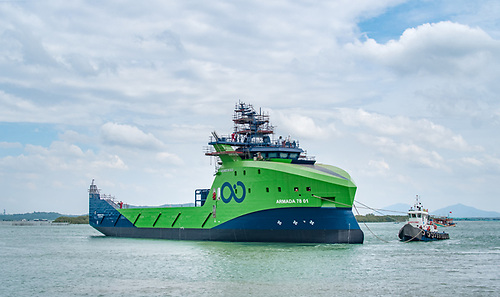
The global maritime industry has officially entered a new era with the completion of a highly advanced fleet of robotic ships. Ocean Infinity recently accepted the delivery of the final vessel in its ambitious Armada program. This last ship is known as Armada 8606 and measures eighty-six meters in length. Its arrival marks the conclusion of a five-year construction initiative that began with the goal of transforming operations at sea. The project was executed in partnership with the Norwegian shipbuilder VARD which utilized its facilities to bring these futuristic designs to life.
This fleet consists of fourteen vessels designed for remote operation and low-emission performance. Twelve of these ships are already active in various regions including the United States and the Asia-Pacific market. The remaining two vessels are scheduled to enter service immediately following their final outfitting. The primary objective of this program is to reduce the number of humans required onboard during hazardous offshore tasks. Operators control the ships from specialized remote centers located on land rather than from the bridge of the vessel itself.
Oliver Plunkett serves as the Chief Executive Officer of Ocean Infinity and has been a vocal advocate for this technological shift. He noted that the completion of the Armada class represents an extraordinary moment for the entire maritime sector. Plunkett emphasized that these ships are not merely concept designs or research projects but are fully functional assets working today. He explained that the company set out to build ships that prioritized speed and capability despite the unconventional nature of the design. His vision focused on using software and technology to change how work is conducted on the ocean.
The construction process involved significant engineering challenges that the Norwegian designers at VARD had to overcome. Each vessel is equipped with hybrid propulsion systems that are prepared for future green fuels like ammonia. This ensures that the fleet remains compliant with tightening environmental regulations while maintaining high efficiency. The transition to robotic shipping allows for a drastic reduction in carbon emissions compared to traditional offshore support vessels. Reducing the crew size also minimizes the risk to human life during difficult weather conditions or dangerous subsea inspections.
Industry experts have compared this transition to the historical shift from sail to steam power. The ability to perform geophysical surveys and infrastructure inspections remotely creates a new paradigm for shipping logistics. While the current phase involves a “lean crew” onboard for safety and supervision, the ultimate aim is fully autonomous operation. The technology onboard allows the vessels to deploy underwater robots and other sensor equipment without manual intervention on the deck. This capability significantly lowers the operational costs associated with long-term offshore missions.
The successful delivery of the Armada 8606 serves as proof that large-scale robotic shipping is no longer a futuristic dream. Companies across the energy and logistics sectors are watching closely to see how these vessels perform in the coming years. As the technology matures, it is likely that other maritime organizations will follow suit with similar autonomous fleets. The implications for the job market and maritime law are immense and will require ongoing adjustment.
Please write your opinion on whether you would trust a fully autonomous ship to navigate the oceans safely in the comments.


