
World’s Smallest AI Supercomputer Fits Comfortably In Your Pocket

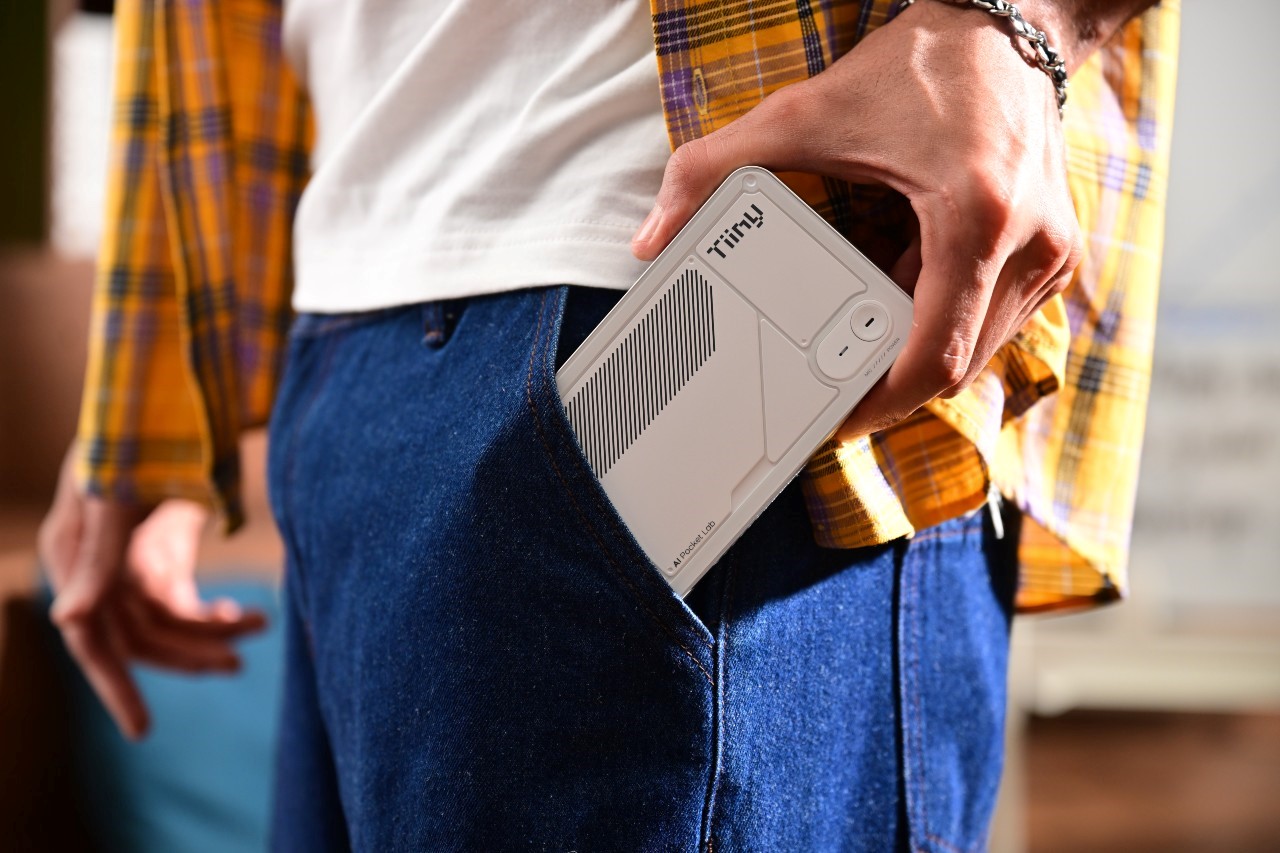
A United States startup has officially redefined the boundaries of portable computing with a new record-breaking device. Tiiny AI recently unveiled the Pocket Lab which the Guinness World Records verified as the smallest personal AI supercomputer in existence. This machine fits into the specific category of the smallest MiniPC capable of running 100-billion parameter language models locally. It packs server-grade power into a chassis that is barely larger than a portable battery pack. The release comes at a time when the industry is desperate for offline solutions that do not compromise on intelligence or speed.
The physical dimensions of the device are incredibly compact at just over 14 centimeters long and roughly 2.5 centimeters thick. Despite weighing only 300 grams, the unit houses a powerful 12-core ARMv9.2 processor and a massive 80 gigabytes of RAM. This memory capacity is critical because it allows the system to store and process huge data sets instantly without external help. The internal storage offers one terabyte of space to ensure users have ample room for their models and archives. The hardware manages to condense the capabilities of a rack server into a handheld form factor.
Users can run sophisticated open-source models like ‘Llama’ or ‘Mistral’ directly on the hardware without any internet connection. This capability addresses the growing demand for privacy by keeping all data processing within the physical device. The system supports models with up to 120 billion parameters which is a feat usually reserved for massive graphics processing units. It effectively eliminates the latency and security risks associated with cloud-based artificial intelligence services. By removing the need for a constant signal, the Pocket Lab ensures that advanced computing is available in any environment.
The engineering team achieved this performance through two key software innovations known as TurboSparse and PowerInfer. TurboSparse optimizes the system by activating only the necessary neurons required for a specific inference task. PowerInfer complements this by splitting the computational workload between the CPU and the neural processing unit. This combination ensures that the device operates efficiently without draining power or overheating during complex operations. The neural processing unit alone delivers nearly 190 trillion operations per second to handle the complex mathematics.
High-level security features make this tool particularly useful for industries that handle sensitive information. The device employs bank-grade encryption to protect the data that is processed and stored on the solid-state drive. It is designed to handle multi-step reasoning and content generation tasks that were previously impossible on mobile hardware. This functionality opens new doors for researchers and developers who need to work in remote locations. Users can perform doctoral-level analysis and deep contextual understanding tasks completely offline.
The philosophy behind the product focuses on democratizing access to powerful computational resources. Samar Bhoj serves as the GTM director for the company and emphasizes that intelligence should belong to people rather than data centers. This launch is part of a broader trend of miniaturizing technology to solve massive problems regarding energy consumption and access. The arrival of such powerful local hardware could signal the end of total reliance on subscription-based cloud AI.
Please share your thoughts on whether you would switch to a local device for your AI needs in the comments.