Hubble Unveils Stunning New View of Dying Star in Remarkable Egg Nebula Image

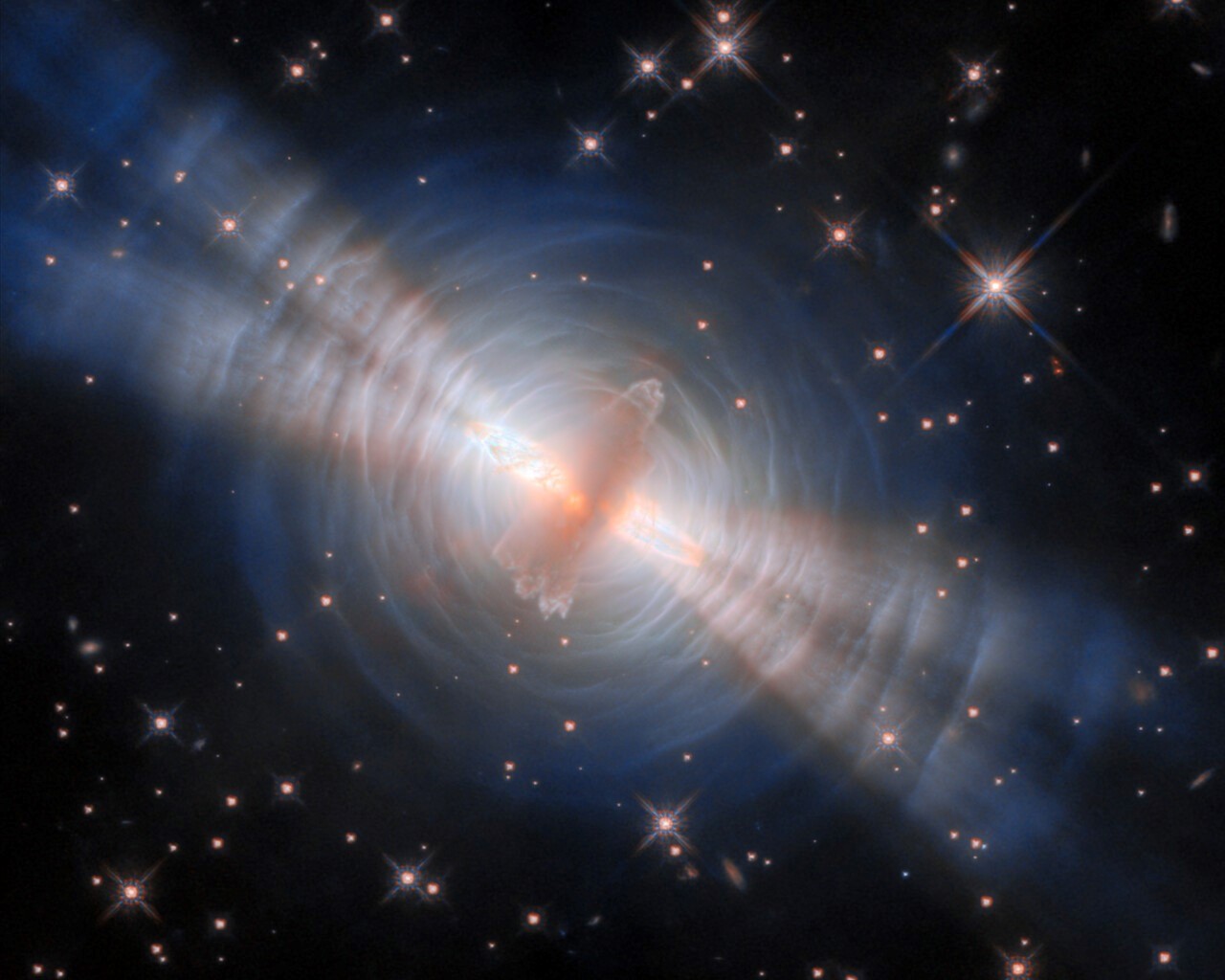
The Hubble Space Telescope has captured an extraordinary new photograph that dives deep into the final chapters of a sun-like star’s existence through the intricate beauty of the Egg Nebula. This pre-planetary nebula represents a brief but crucial phase where the aging star sheds its outer layers of gas and dust in preparation for its transformation into a white dwarf. What makes this object so captivating is its visibility despite the challenges typically faced when observing such structures. Powerful beams of light from the hidden central star pierce through the surrounding dust, creating illuminated pathways that highlight the nebula’s complex form against the darkness of space.
At the heart of this cosmic scene lies a dense cloud that completely obscures the star itself from direct observation. Yet the star’s influence is undeniable as it sends out intense rays that light up the expelled material in spectacular fashion. Fast-moving streams of hot molecular hydrogen erupt near the base of these beams, glowing in infrared wavelengths that appear as vibrant orange hues in the image. The European Space Agency has described this illuminated structure as resembling a precious jewel floating in the vast cosmos, emphasizing its rare and enchanting appearance.
Surrounding the central opaque region are delicate concentric rings made up of thin gas arcs. These features form from regular outbursts of matter from the star’s surface happening every few hundred years. As the star’s light bounces off these layers, it produces a ripple-like effect much like waves spreading across water. The scattering of light by gas molecules gives the arcs their distinctive soft blue tint, adding to the overall ethereal quality of the scene.
This reflected light plays a vital role beyond mere aesthetics since it allows scientists to infer important details about the concealed star’s properties even without seeing it directly. The Egg Nebula stands out among similar objects because its central star has not yet grown hot enough to ionize the surrounding gas and make it glow independently. Instead, the illumination comes purely from the star’s beams cutting through the dust envelope from opposite sides. Such dynamics offer a unique window into the processes that govern how stars like our Sun eventually discard their envelopes and evolve.
In the broader context, the image backdrop filled with distant stars and their characteristic diffraction patterns underscores the nebula’s role as a natural laboratory. Researchers gain valuable insights here into the mechanisms driving stellar death and the creation of planetary nebulae that will follow. This transitional stage, though short-lived on astronomical timescales, reveals the dramatic ejections and structural complexities involved in a star’s endgame. Observations like these continue to refine our understanding of what awaits our own solar system in the distant future.
The combination of visible and infrared data in this latest Hubble release brings out details that would otherwise remain hidden. From the orange infrared emissions signaling energetic flows to the blue-tinged reflective arcs, every element tells part of the story of stellar evolution. As the nebula gradually expands and changes, it will one day fully unveil its core white dwarf while leaving behind a glowing shell. For now, this snapshot freezes a moment of intense activity and beauty in a process that shapes the universe’s recycling of matter.
What aspects of stellar death or cosmic nebulae intrigue you the most, and how do images like this one change your perspective on the life cycles of stars? Share your thoughts in the comments.