Amazon Launches Drone Delivery Service in Dallas-Fort Worth Metro Area

Amazon has rolled out its Prime Air drone delivery program to select neighborhoods in the Dallas-Fort Worth area, marking the first U.S. commercial deployment of autonomous aerial packages weighing up to five pounds. The initiative promises deliveries within 60 minutes of ordering, leveraging FAA-approved beyond-visual-line-of-sight operations to bypass ground traffic delays. This expansion tests scalability in a high-density urban corridor, where e-commerce volumes exceed 1.2 billion parcels annually.
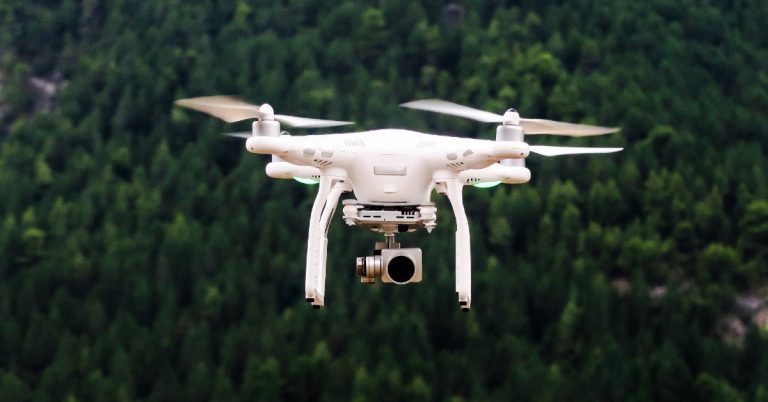
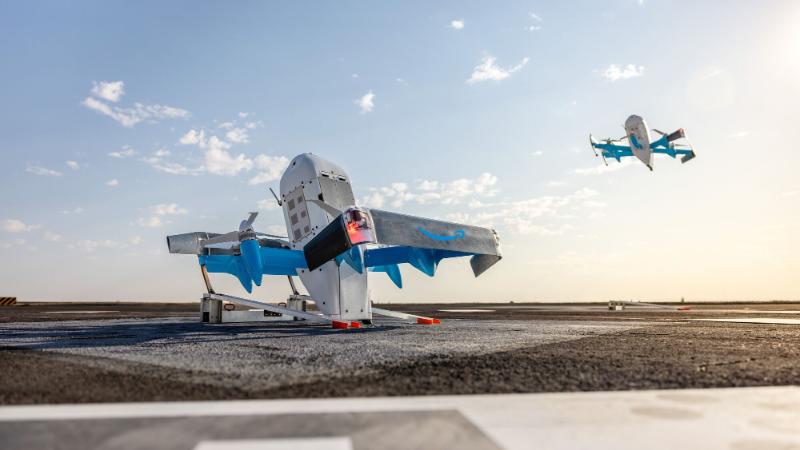
Prime Air employs the MK30 drone model, a hexacopter with redundancy in propulsion and navigation systems, capable of vertical takeoff and landing within a 15-by-15-foot footprint. Equipped with sense-and-avoid radar and LiDAR sensors, the drone detects obstacles up to 300 feet ahead, complying with FAA Part 135 certification standards. Packages attach via a winch system that lowers payloads 80 feet to the ground without landing, minimizing noise at 65 decibels—equivalent to a conversation. Amazon’s 2025 fleet includes 500 units, with production scaled at its Auburn, Washington facility.
The Dallas-Fort Worth launch follows two years of testing in College Station, Texas, where 200 flights per week achieved 98% on-time rates under variable weather conditions up to 10-knot winds. Regulatory approvals under the FAA’s UAS Integration Pilot Program enabled integration with airspace managed by the Dallas-Fort Worth Air Route Traffic Control Center, which handles 2,500 daily flights. Amazon coordinates via a dedicated Unmanned Aircraft System Traffic Management system, prioritizing drone paths below 400 feet to avoid manned aviation corridors.
Initial rollout targets 10 ZIP codes spanning Irving and Grand Prairie, serving Prime members with orders from everyday essentials like groceries and over-the-counter medications. Eligibility requires addresses at least 100 feet from power lines and airports, with deliveries restricted to daylight hours between 7 a.m. and 9 p.m. Amazon reports that drone shipments reduce carbon emissions by 80% compared to van deliveries over short distances, aligning with its 2040 net-zero goal. Early adopters receive notifications via the Prime app, including live tracking and estimated arrival times accurate to within two minutes.
Challenges include public acceptance and wildlife interactions, addressed through community outreach and acoustic deterrents tuned to avian frequencies. The program employs 50 local operators monitoring flights from a 10,000-square-foot control center in Irving, equipped with real-time telemetry feeds and automated failover protocols. Integration with Amazon’s logistics network allows seamless handoff from fulfillment centers like the one in Haslet, processing 4 million units daily.
Broader implications extend to last-mile innovation, where drones could capture 20% of urban deliveries by 2030, per McKinsey projections, easing congestion on highways carrying 1.5 million vehicles daily in the metro area. Competitors like Wing and Zipline operate in similar markets, but Amazon’s scale—handling 40% of U.S. e-commerce—positions it to lead. The FAA’s 2025 reauthorization act eases certification for heavier payloads, potentially expanding to 50-pound capacities by 2027.
For Texas consumers, the service underscores e-commerce evolution, blending aerial efficiency with ground reliability. Amazon plans phased growth to 50 neighborhoods by mid-2026, contingent on incident-free operations below a 0.1% failure threshold. This deployment not only accelerates package flow but also pioneers airspace commercialization, setting precedents for nationwide adoption.