A Mysterious State Of Matter Is Likely Flowing Inside Earths Core

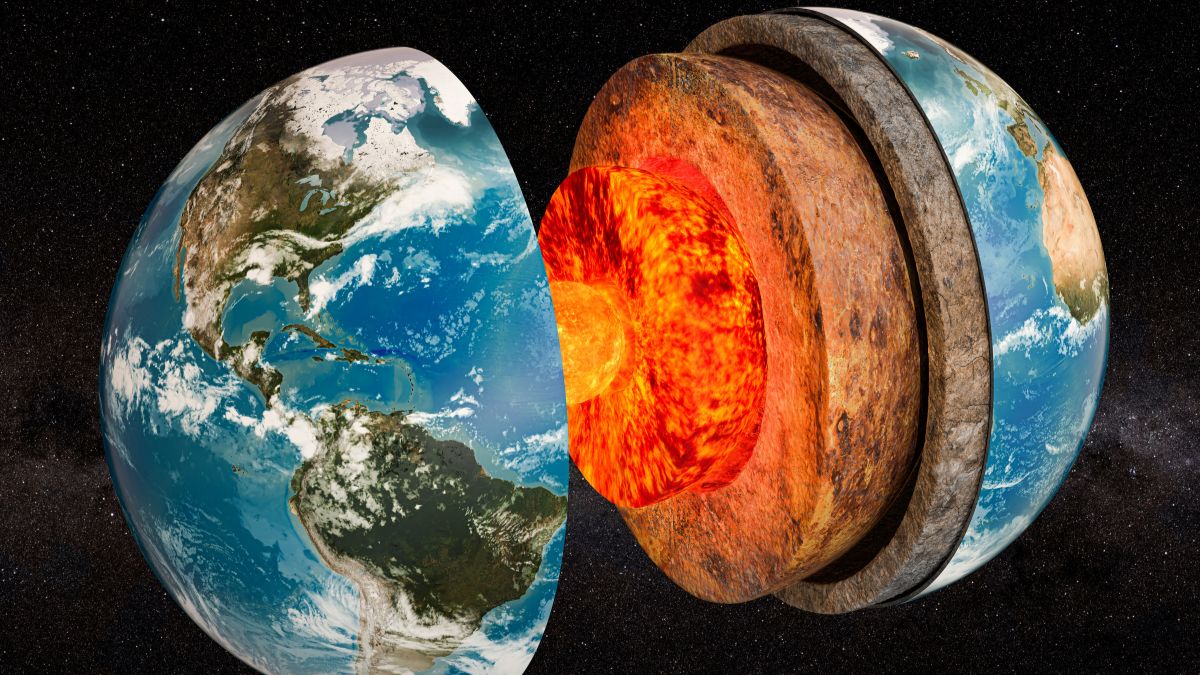
For nearly a century, science has taught us that the center of our planet is a solid metal ball encased in liquid. We learned that a molten outer core surrounds a dense inner core of compressed iron alloy. However, new research suggests that this picture is far from complete. Scientists have discovered that the inner core might actually exist in a strange superionic state that is neither fully solid nor entirely liquid.
Physicists have long been puzzled by seismic data showing that earthquake waves slow down significantly when passing through the center of the planet. This anomaly suggested that the core was softer than solid iron should be. To investigate this, researchers led by Youjun Zhang at Sichuan University conducted high-velocity experiments. They fired iron-carbon alloy projectiles at extreme speeds to replicate the intense pressure found deep underground.
The results confirmed theoretical models previously proposed by Yu He from the Chinese Academy of Sciences. The experiments revealed that under core-like conditions, the iron atoms remain in a rigid lattice structure while lighter elements move freely. Carbon, hydrogen, and oxygen appear to flow through the solid iron framework like a liquid. This creates a hybrid state of matter that defies traditional categorization.
Youjun Zhang described the phenomenon vividly by comparing the carbon atoms to children weaving through a square dance while the iron adults stay in place. This movement allows the material to behave like a solid in some ways and a liquid in others. The fluid-like motion of the light elements dampens vibrations, which explains why seismic shear waves lose speed. It solves the long-standing mystery of why the inner core appears so squishy to seismologists.
Understanding this superionic state provides crucial insight into how our planet functions. The continuous convection of these light elements could be a key driver of the Earth’s magnetic field. This protective shield is vital for sustaining life on the surface by deflecting harmful solar radiation. These findings might also help us understand the internal composition of other celestial bodies in our solar system.
This discovery challenges the static models of planetary interiors that have dominated textbooks for decades. It implies that the Earth is far more dynamic and complex on the inside than we ever realized. Future missions and simulations will likely focus on how these superionic materials influence the rotation and thermal history of our world. The boundary between solid and liquid is clearly not as sharp as we once believed.
If you have any theories about what else might be hiding in the center of the Earth, please share your thoughts in the comments.