SpaceX Plans Blockbuster 2026 IPO to Raise Over $25 Billion

SpaceX prepares to launch one of the largest initial public offerings in history, targeting more than $25 billion in new capital during the second half of 2026. The move comes as the company solidifies its dominance in reusable rocket technology and satellite internet services, with discussions already underway with investment banks for a potential June or July listing. Elon Musk, who holds 42 percent of the company’s equity, confirmed the plans in a recent exchange on X, validating earlier reports from industry analysts.
The IPO aligns with SpaceX’s rapid operational scaling, including over 160 Falcon 9 launches in 2025 alone, which accounted for more than 80 percent of global orbital payloads by weight. This milestone reflects the company’s reusable rocket architecture, where Falcon 9 boosters have completed up to 25 flights each, reducing launch costs to approximately $67 million per mission compared to competitors’ $200 million-plus figures. Starlink, SpaceX’s satellite constellation, now comprises over 10,000 active satellites, delivering broadband to more than 5 million subscribers across 125 countries and generating $9.3 billion in revenue for the fiscal year ending December 2024.
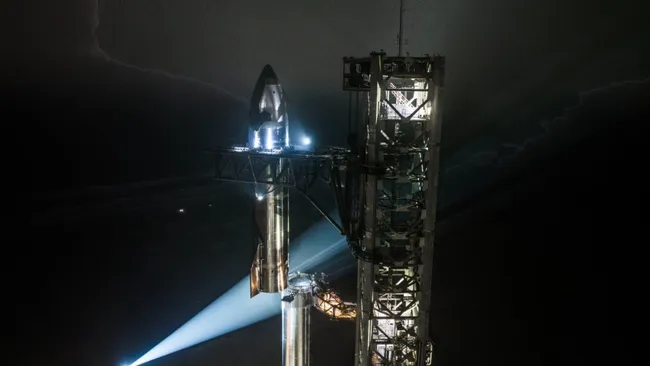
Starlink’s expansion drives much of the valuation optimism, with the service achieving positive cash flow in 2024 and projecting $12.5 billion in 2025 revenue. The network supports direct-to-cell connectivity trials with partners like T-Mobile, enabling texting in remote areas without terrestrial infrastructure. SpaceX’s Starship program, designed for full reusability and capable of carrying 150 metric tons to low Earth orbit, advances toward crewed Mars missions, with the fifth test flight scheduled for early 2026. These developments position SpaceX as a critical asset for U.S. national security, securing contracts worth $3.8 billion from the Department of Defense in 2025 for satellite deployments and cargo resupply.
The offering could value SpaceX at over $1 trillion, surpassing current private valuations of $800 billion from a recent secondary share sale and eclipsing OpenAI’s $500 billion mark. Investment banks like Goldman Sachs and Morgan Stanley lead the discussions, structuring the deal to maintain Musk’s controlling stake while attracting institutional investors. Fidelity and Founders Fund, each holding about 10 percent, stand to benefit alongside Alphabet’s 7.4 percent position. Regulatory filings with the Securities and Exchange Commission are expected in the first quarter of 2026, subject to market conditions and Federal Aviation Administration approvals for ongoing launches.
This public debut marks a shift from SpaceX’s private funding model, which has raised $13.5 billion since 2002 from 300-plus investors. The capital influx will fund Starship production scaling to 100 vehicles annually and Starlink’s direct-to-mobile rollout, targeting 1 billion users by 2030. For the U.S. space economy, valued at $500 billion in 2025, the IPO injects liquidity into a sector reliant on government contracts comprising 60 percent of SpaceX’s $15 billion annual revenue. Competitors like Blue Origin and United Launch Alliance face intensified pressure, as SpaceX’s cost efficiencies erode their market share in medium-lift launches.
Musk’s confirmation followed a Reuters report citing a source close to the company, emphasizing the listing’s role in fueling interplanetary ambitions. SpaceX’s vertical integration—from propellant production to satellite manufacturing—yields gross margins exceeding 40 percent on launches, far above industry averages of 20 percent. The IPO proceeds, estimated at 2 to 3 percent of the company’s post-listing market cap, will prioritize R&D for Starship’s orbital refueling demonstrations, essential for lunar landings under NASA’s Artemis program.
As SpaceX transitions to public markets, investor scrutiny will intensify on execution risks, including Starship’s development delays and regulatory hurdles from the FAA’s environmental reviews. Yet, with 95 percent launch success rates and contracts for 60 percent of NASA’s civil missions, the company commands a premium multiple of over 40 times projected 2026 revenue. This valuation reflects not just aerospace prowess but SpaceX’s pivot toward infrastructure, where Starlink challenges traditional telecoms and enables remote defense operations. The 2026 IPO underscores a maturing space industry, where private innovation outpaces public funding, potentially unlocking $100 billion in annual global investments by decade’s end.