SpaceX Aborts Super Heavy Catch But Successfully Reignites Raptor in Orbit

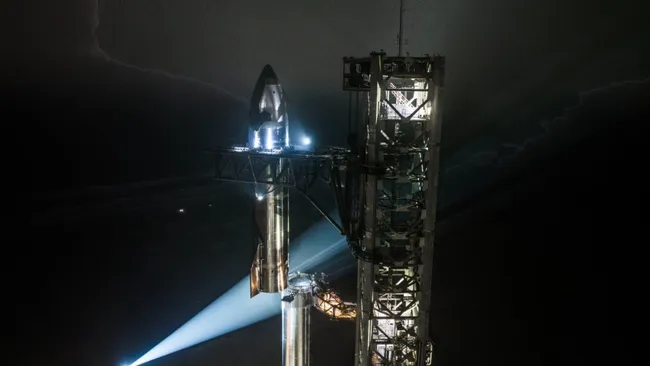
SpaceX launched the sixth test flight of its massive Starship rocket on Tuesday afternoon, sending the 400-foot vehicle aloft from its Starbase facility in Boca Chica, Texas, at 4:00 PM CST. The mission, powered by the 33 Raptor engines of the Super Heavy booster, aimed to repeat the historic mid-air capture of the rocket’s first stage, a feat successfully demonstrated for the first time last month. However, flight directors issued a command to abort the capture attempt just minutes after liftoff, citing a failure to meet specific “automated health checks” regarding the critical hardware on the launch tower’s mechanical arms.
Rather than returning to the “Mechazilla” launch tower, the Super Heavy booster executed a pre-programmed diversion maneuver to a safe zone in the Gulf of Mexico. Telemetry data confirmed that the booster performed a controlled descent and landing burn, achieving a soft splashdown in the water approximately seven minutes after launch. While the cancellation of the catch was a disappointment to the crowds gathered near South Padre Island, company representatives emphasized that the safety of the launch infrastructure and surrounding area remained the primary criteria for attempting the complex “chopstick” capture.
The primary payload for this mission was the Starship upper stage, designated Ship 31, which continued its ascent to an altitude of approximately 118 miles (190 kilometers). During its coast phase in the vacuum of space, the spacecraft achieved a significant engineering milestone by successfully reigniting a single Raptor engine. This in-space engine burn is a critical capability required for future orbital missions, as it demonstrates the vehicle’s ability to perform controlled deorbit burns necessary to return safely to Earth from stable orbit without relying on atmospheric drag alone.
Engineers also used this flight to push the limits of the Starship’s thermal protection system by intentionally removing heat shield tiles from specific sections of the fuselage. These gaps were designed to simulate the mounting points for future catch-enabling hardware, allowing the team to gather real-world data on how the stainless steel structure withstands the extreme heat of hypersonic reentry. Despite the compromised heat shield and a steeper-than-usual angle of attack during descent, the ship maintained structural integrity as it sliced through the atmosphere at speeds exceeding 15,000 miles per hour.
The mission concluded with the ship executing a controlled landing flip and splashdown in the Indian Ocean, roughly 65 minutes after launch. Unlike previous tests conducted at night, this daylight landing provided high-definition visual confirmation of the vehicle’s performance, showing the ship remaining upright and intact as it hit the water. The successful splashdown marks the final flight for the “Block 1” generation of Starship vehicles, as SpaceX prepares to transition to upgraded “Block 2” prototypes that feature larger propellant tanks and redesigned forward flaps for improved aerodynamic control.
Data collected from Flight 6 will directly inform the timeline for NASA’s Artemis 3 mission, which currently relies on a specialized variant of Starship to land astronauts on the Moon. NASA Administrator Bill Nelson publicly congratulated SpaceX on the successful engine reignition, noting that the test keeps the program moving toward a potential manned lunar landing later this decade. SpaceX is expected to increase its launch cadence significantly in 2025, with hardware for the next several flights already undergoing testing at the Texas manufacturing site.